Cybersecurity for SMEs - Safeguarding UK Business Integrity
- Gary Sinnott

- Jan 4
- 8 min read

Cyber attacks do not discriminate, and over 50% of British businesses suffered a cyber breach or attack in 2024. For IT managers in legal, financial, and healthcare SMEs across the United Kingdom, the risks are real and often misunderstood. Tackling strict compliance demands and sophisticated threats calls for more than basic security tools. This article demystifies SME cybersecurity, exposes dangerous misconceptions, and offers sector-specific guidance to help you build robust, regulation-ready defence strategies.
Table of Contents
Key Takeaways
Point | Details |
SMEs Are Vulnerable to Cyber Threats | Contrary to common misconceptions, SMEs are prime targets for cybercriminals due to weaker security measures and valuable data assets. |
Comprehensive Cybersecurity Approach Is Essential | Cybersecurity encompasses technology, processes, and people; fostering a strong security culture is critical for safeguarding digital assets. |
Key Cyber Threats Include Ransomware and Phishing | SMEs face significant risks from ransomware attacks and sophisticated phishing scams, making robust protective measures necessary. |
Compliance Is Complex but Crucial | Navigating compliance frameworks like UK GDPR and NIST is essential for SMEs to ensure legal adherence and robust cybersecurity practices. |
Defining SME Cybersecurity and Common Misconceptions
Cybersecurity for small and medium enterprises (SMEs) in the United Kingdom is far more complex than many business leaders realise. Despite prevalent myths, cyber threats do not discriminate based on company size. Research from the Association of British Insurers reveals that 50% of UK businesses experienced a cyber breach or attack in 2024, with SMEs particularly vulnerable.
The most dangerous misconception is that small businesses are too insignificant to attract cybercriminal attention. In reality, SMEs often present easier targets due to limited security infrastructure. Cybercriminals view smaller organisations as low-hanging fruit, exploiting weaker defences and assuming these businesses lack sophisticated monitoring capabilities. They understand that SMEs frequently have valuable data assets – customer information, financial records, intellectual property – without robust protective measures.
Understanding cybersecurity requires recognising its holistic nature. It is not merely about technological solutions but encompasses people, processes, and technological safeguards. The Information Commissioner’s Office guidance emphasises that comprehensive cybersecurity involves responsible data handling, proactive breach prevention, and maintaining regulatory compliance. This means developing a security culture where every team member understands their role in protecting organisational digital assets.
Pro tip: Conduct a monthly 30-minute team cybersecurity awareness session to keep your staff informed about emerging digital threats and best protective practices.
Top Cyber Threats Impacting UK SMEs
Ransomware remains the most devastating cyber threat targeting UK small and medium enterprises. The National Crime Agency reports that financially motivated criminal groups are increasingly sophisticated in exploiting SME vulnerabilities, with attacks potentially causing complete operational shutdown and catastrophic financial losses.
Beyond ransomware, SMEs face a complex landscape of cyber threats. Phishing scams targeting employee credentials represent a particularly insidious risk, allowing attackers to gain unauthorised system access through seemingly innocuous email communications. Social engineering techniques have become increasingly refined, with cybercriminals crafting messages that appear legitimate and bypass traditional security measures. These attacks often exploit human psychology, tricking staff into revealing sensitive login information or inadvertently installing malicious software.

Operational Technologies (OT) create additional vulnerability points for industrial SMEs. Government research highlights that critical infrastructure sectors like manufacturing and utilities face significant risks from cyber intrusions. Many OT systems lack modern security features, making them attractive targets for attackers seeking political or financial disruption. The potential consequences extend beyond immediate financial damage, potentially compromising national economic security and causing widespread operational chaos.
Pro tip: Implement mandatory quarterly cybersecurity training for all staff, focusing on recognising sophisticated phishing attempts and maintaining strict access control protocols.
The following table summarises the primary cyber threats faced by UK SMEs alongside typical consequences experienced.
Threat Type | Attack Method | Typical Consequences |
Ransomware | Malicious encryption | Business disruption and financial loss |
Phishing | Deceptive emails | Data theft and unauthorised access |
Social Engineering | Psychological tricks | Credentials compromise |
OT Vulnerabilities | Industrial system hacks | Operational failures and service loss |
Essential Cybersecurity Controls and Compliance Frameworks
Cybersecurity compliance for UK small and medium enterprises involves navigating a complex landscape of legal and regulatory requirements. Academic research from the Global Cyber Security Centre reveals that SMEs must adhere to multiple critical frameworks, including the UK General Data Protection Regulation (GDPR), Data Protection Act 2018, and the Network and Information Systems (NIS) Regulations. These frameworks mandate comprehensive security risk management strategies that go beyond simple technological solutions.
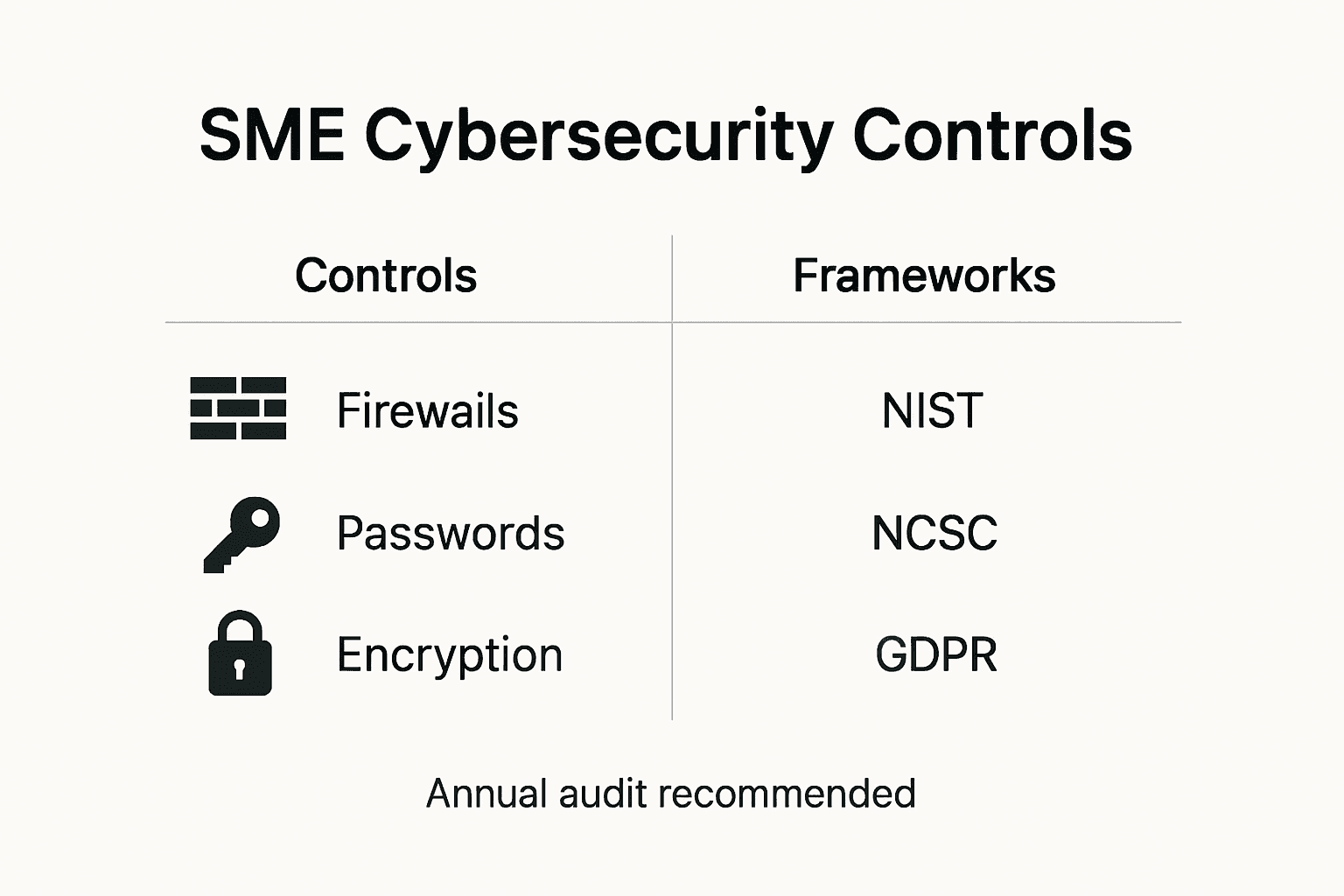
Key compliance frameworks provide structured approaches to cybersecurity management. The National Institute of Standards and Technology (NIST) Cybersecurity Framework and the National Cyber Security Centre (NCSC) Cyber Assessment Framework offer SMEs practical guidelines for identifying, protecting, detecting, responding to, and recovering from cyber incidents. These frameworks emphasise a proactive approach, encouraging businesses to develop robust incident response plans and continuously assess their security posture.
Government guidance from the Department for Work and Pensions highlights the importance of creating a business-focused, risk-informed cybersecurity culture. This approach requires SMEs to implement mandatory security controls that protect the confidentiality, integrity, and availability of their systems. Critical controls include multi-factor authentication, regular security awareness training, robust access management, and comprehensive vulnerability management processes.
Pro tip: Conduct an annual comprehensive compliance audit, mapping your current security controls against NIST and NCSC frameworks to identify and address potential gaps in your cybersecurity strategy.
Below is a comparison of major cybersecurity compliance frameworks relevant for UK SMEs.
Framework | Core Focus | Applicability for SMEs |
UK GDPR | Data protection regulation | Mandatory for handling personal data |
Data Protection Act 2018 | Legal data handling standards | Broadly required for all UK businesses |
NIS Regulations | Network infrastructure security | Applies to specific sectors, e.g., utilities |
NCSC Cyber Assessment | Security best practice | Voluntary but highly recommended |
NIST CSF | Risk management and response | Internationally recognised, scalable for SMEs |
Role of Strategic Security Leadership (vCISO)
Strategic security leadership represents a critical evolution in cybersecurity management for UK small and medium enterprises. Enterprise research highlights that virtual Chief Information Security Officers (vCISOs) play a transformative role in fostering a comprehensive cybersecurity culture, enabling risk-informed decision-making, and integrating security strategies directly into business objectives. Unlike traditional IT security approaches, a vCISO provides executive-level strategic guidance tailored specifically to an organisation’s unique technological landscape and risk profile.
The vCISO’s responsibilities extend far beyond technical implementation. They serve as a strategic partner, translating complex cybersecurity challenges into clear, actionable business language. This includes developing robust security frameworks, conducting thorough risk assessments, managing compliance requirements, and creating incident response strategies. By providing on-demand, flexible expertise, vCISOs enable SMEs to access high-level security leadership without the significant overhead of a full-time executive position.
The UK Cyber Growth Action Plan underscores the critical role of leadership in driving national cybersecurity capabilities. For SMEs, a vCISO represents more than a tactical resource – they are strategic enablers of digital resilience. They help organisations navigate increasingly complex regulatory environments, align security investments with business goals, and build a proactive security culture that views cybersecurity as a fundamental business enabler rather than a mere compliance requirement.
Pro tip: Schedule quarterly strategy sessions with your vCISO to ensure continuous alignment between your cybersecurity strategy and evolving business objectives.
Proactive Risk Management and Resilience Strategies
Operational resilience represents a sophisticated approach to cybersecurity that goes beyond traditional defensive measures. Research from the Association of British Insurers highlights that many UK SMEs significantly underestimate their cyber risk exposure, leaving themselves vulnerable to potentially catastrophic digital disruptions. Effective risk management requires a holistic strategy that anticipates, withstands, and rapidly recovers from cyber incidents.
A comprehensive resilience framework involves multiple strategic components. This includes thorough risk identification, establishing clear impact tolerances, mapping critical business resources, and conducting rigorous scenario testing. SMEs must develop robust incident response plans that outline precise protocols for detecting, containing, and mitigating potential cyber threats. These plans should be living documents, regularly updated to reflect evolving technological landscapes and emerging threat vectors.
The Guidance for Firm Operational Resilience provides a structured methodology for embedding resilience into organisational DNA. Key elements include establishing clear governance structures, defining accountability mechanisms, and creating a culture that views cybersecurity as a continuous, dynamic process. This approach transforms risk management from a compliance checkbox into a strategic business enabler that protects organisational value and maintains stakeholder confidence.
Pro tip: Create a cross-functional incident response team with representatives from IT, legal, communications, and senior management to ensure comprehensive and coordinated cyber threat management.
Navigating Sector-Specific Legal Requirements
Legal compliance represents a critical challenge for UK small and medium enterprises across diverse industry sectors. The Information Commissioner’s Office provides comprehensive guidance tailored specifically to help SMEs understand their nuanced data protection and privacy obligations under the United Kingdom General Data Protection Regulation (UK GDPR). Different sectors encounter unique regulatory landscapes that demand precise, targeted approaches to legal risk management.
Healthcare, financial services, and legal firms face particularly stringent regulatory requirements. These sectors must implement robust data handling protocols, maintain meticulous record-keeping standards, and develop comprehensive privacy frameworks that protect sensitive client information. Compliance involves more than simple documentation – it requires establishing systematic processes that demonstrate ongoing commitment to legal and ethical data management practices. SMEs must develop proactive strategies that anticipate regulatory expectations and create scalable compliance infrastructures.
The LawTech and SMEs report highlights the critical distinction between reactive and proactive legal approaches. Successful SMEs do not merely respond to legal challenges but actively develop strategies that integrate compliance into their core business operations. This means understanding sector-specific regulations, investing in staff training, and creating flexible frameworks that can adapt to evolving legal landscapes. Technology and legal expertise must work in concert to create comprehensive compliance solutions that protect both business interests and client rights.
Pro tip: Conduct an annual comprehensive legal compliance audit that maps your current practices against the latest sector-specific regulatory requirements.
Strengthen Your SME Cybersecurity with Expert Strategic Leadership
Cyber threats exploit vulnerabilities in SMEs that often go unnoticed until it is too late. Your business cannot afford to underestimate risks like ransomware, phishing, or operational technology attacks that could disrupt operations and cause financial harm. The article highlights the importance of a holistic security culture backed by proactive risk management and compliance frameworks such as Cyber Essentials and ISO 27001. If you want true digital resilience instead of just ticking compliance boxes, you need a strategic approach tailored to your unique business risks.
Take control of your cybersecurity journey today with Freshcyber’s virtual Chief Information Security Officer (vCISO) service. Our vCISO acts as the executive brain behind your security strategy, delivering gap analysis, risk prioritisation, policy management, and compliance leadership aligned with frameworks like Cyber Essentials and SME Security. Our hands-on vulnerability and penetration testing services uncover hidden weaknesses before attackers do. Protect your business from catastrophic disruption by partnering with us now—start with a free penetration test to identify your current exposure at Freshcyber.
Secure your SME’s future by moving beyond reactive defence to strategic resilience. Connect with Freshcyber today and make cybersecurity a true business enabler.
Frequently Asked Questions
What are the primary cyber threats faced by SMEs?
SMEs primarily face threats such as ransomware, phishing scams, social engineering attacks, and vulnerabilities in operational technologies (OT). Each of these threats can result in significant operational disruptions and financial losses.
How can SMEs enhance their cybersecurity posture?
SMEs can enhance their cybersecurity by implementing key controls such as multi-factor authentication, regular security awareness training for staff, and robust access management. Additionally, conducting regular security audits and developing incident response plans are crucial.
What compliance frameworks should SMEs be aware of regarding cybersecurity?
SMEs should be familiar with frameworks including the UK General Data Protection Regulation (GDPR), Data Protection Act 2018, and Network and Information Systems (NIS) Regulations. These frameworks dictate essential security practices and compliance requirements.
How can a virtual Chief Information Security Officer (vCISO) support SMEs?
A vCISO provides strategic guidance on cybersecurity management tailored to an SME’s specific risk profile and technological environment. They help develop security frameworks, manage compliance, and promote a strong cybersecurity culture within the organisation.
Recommended
Comments