Cyber Security Compliance Workflow for ISO 27001 Success


Facing pressure to secure contracts and satisfy auditors, many British FinTech leaders are realising that compliance is no longer just a tick-box exercise. With complex regulations like DORA and stringent sector standards shaping client demands, establishing ISO 27001:2022 compliance has become vital for robust audit readiness and business credibility. This guide provides clear steps for identifying regulatory obligations, conducting a formal gap analysis, and building evidence-based controls that help British FinTech firms prove resilience and win trust with stakeholders.
Table of Contents
Quick Summary
Key Point | Explanation |
1. Understand Regulatory Requirements | Identify all applicable regulations and compliance obligations for your FinTech business, including DORA and data protection laws. |
2. Conduct a Gap Analysis | Assess your current security controls honestly to determine where improvements are necessary for ISO 27001:2022 compliance. |
3. Prioritise Cyber Risk Gaps | Evaluate and score security gaps based on risk, ensuring your team focuses on the most critical issues first. |
4. Develop a Remediation Plan | Create a phased action plan for addressing security gaps, outlining resources, timelines, and responsibilities for implementation. |
5. Prepare for Compliance Audits | Verify the effectiveness of your controls and documentation thoroughly before an audit to ensure a smooth evaluation process. |
Step 1: Assess regulatory requirements and current posture
Before you build anything, you need to understand what you’re building towards. This step focuses on identifying which regulations apply to your FinTech business and honestly evaluating where you stand right now. This foundation determines everything that follows in your ISO 27001:2022 journey.
Start by mapping your regulatory obligations. Your FinTech firm operates in a heavily regulated sector, so you likely have multiple compliance requirements layered on top of each other. Understanding UK cyber security regulations for SMEs is essential, particularly DORA (Digital Operational Resilience Act) and any sector-specific standards your clients demand. Make a list of every regulation that touches your business, not just cyber security but data protection, financial services rules, and industry-specific requirements.
Next, conduct an honest gap analysis of your current state. Walk through your business and document what security controls already exist. Do you have documented policies? Is there an incident response plan? What about access controls, encryption, or staff training? Be specific. Don’t pretend a fragmented spreadsheet is a proper access management system. This real picture reveals exactly how far you need to travel to reach ISO 27001:2022 compliance.
Engage your team in this assessment. Your technical staff know where the weak spots are. Your finance team understands data flows and vendor relationships. Your operations team manages physical security and business continuity. Conversations across these groups often uncover risks no single person sees alone. You’ll spot patterns and dependencies that matter when you start building controls.
Document everything clearly. Create a register that lists each regulatory requirement, maps it to relevant ISO 27001:2022 controls, and notes your current compliance status against it. This becomes your roadmap and proves your due diligence to auditors later. When you’re preparing for a cyber audit, this documentation will be invaluable.
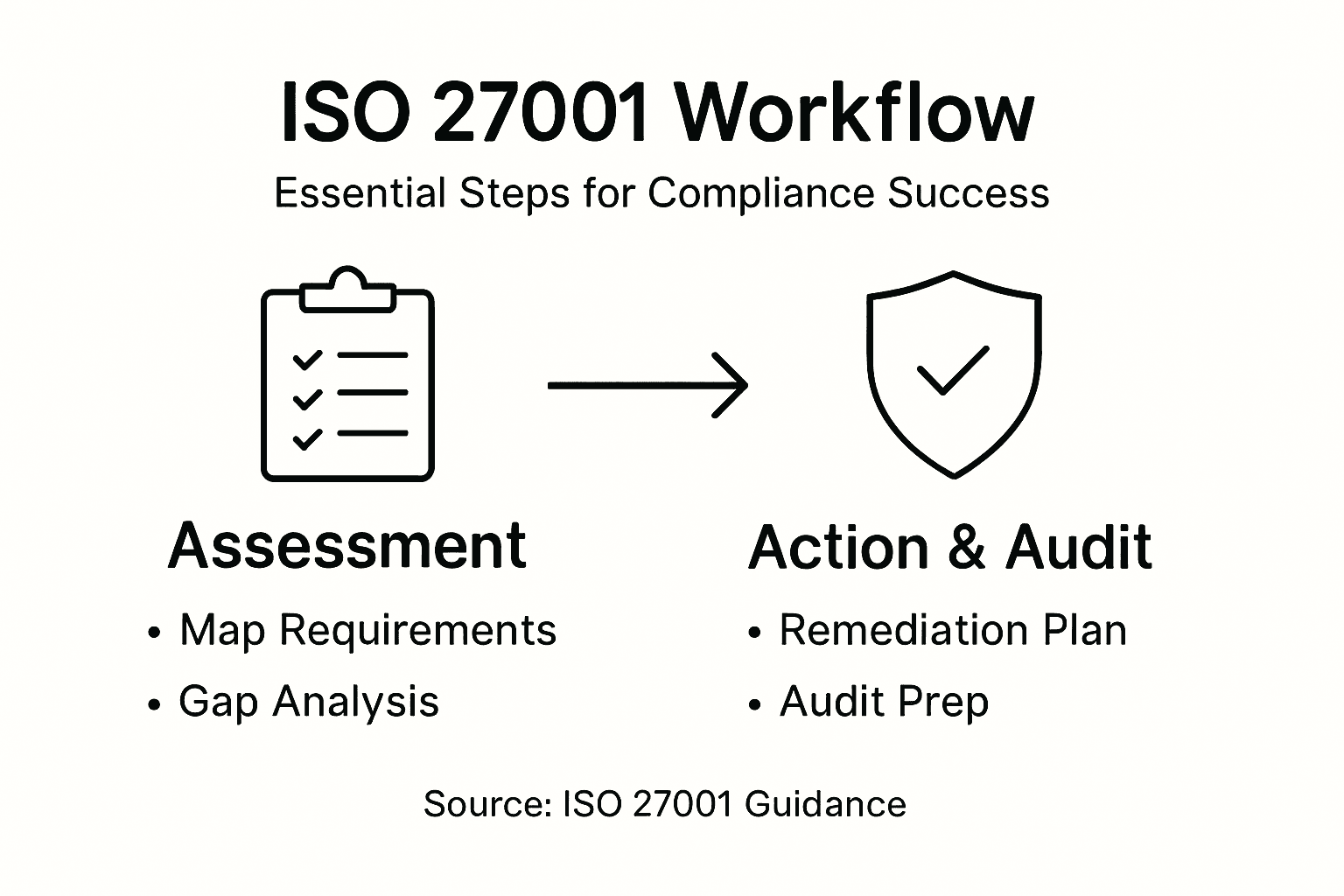
Below is a comparison of common FinTech regulations and how they align with ISO 27001:2022 controls:
Regulation or Standard | Primary Focus | Example ISO 27001 Control | Business Impact |
DORA | Operational resilience | A.17.1 | Ensures preparedness for cyber incidents |
GDPR | Data protection & privacy | A.8.2 | Protects customer and personal data |
FCA Handbook | Financial operational controls | A.18.1 | Adheres to financial sector compliance |
PCI DSS | Payment card data protection | A.12.6 | Secures payment processing & reputation |
This table helps clarify which regulations require alignment with relevant ISO controls.
Professional advice Record your findings in a formal gap analysis document rather than scattered notes. This demonstrates rigour to auditors and gives you something to reference when prioritising remediation work over the coming months.
Step 2: Identify and prioritise cyber risk gaps
Now that you understand your regulatory landscape and current state, it’s time to pinpoint exactly where your security falls short. This step transforms your gap analysis into a prioritised action plan that focuses your limited resources on the risks that matter most to your FinTech business.
Start by conducting a systematic gap analysis against ISO 27001:2022 controls. An ISO 27001 gap analysis compares your current information security posture against the standard’s requirements, highlighting which controls exist, which are ineffective, and which are missing entirely. This isn’t about being perfect. It’s about being honest about where you actually stand versus where you need to be.
Score each gap based on risk severity and business impact. Not all gaps are created equal. A missing access control in your customer database demands immediate attention, whilst outdated documentation in a non-critical system can wait. Use a simple framework to rate each gap by likelihood of exploitation, potential impact on your operations, and relevance to your DORA compliance obligations. This prioritisation ensures your team tackles the highest impact vulnerabilities first.
Involve your business stakeholders in this prioritisation process. Your finance director cares about fraud risks and regulatory fines. Your technical team understands implementation effort and complexity. Your risk manager sees the broader picture. When these perspectives align on priority, you build consensus and secure buy-in for remediation spending. Understanding cyber risk management for SMEs helps frame these conversations around business value rather than technical jargon.
Document your prioritised risk register clearly. List each gap, its risk score, the specific ISO 27001:2022 control it affects, and the potential business consequence if left unaddressed. This register becomes your roadmap for the next 12 months and your evidence for auditors that you’ve applied rigorous risk thinking to your compliance programme.
Professional advice Separate quick wins from long-term projects in your risk register. Quick wins build momentum and demonstrate progress to leadership, whilst the longer remediation efforts continue in parallel.
Step 3: Develop actionable remediation and investment plan
You’ve identified your gaps and prioritised them. Now comes the practical work of turning that prioritised list into a concrete plan with timelines, resource allocation, and budget. This step bridges the gap between identifying problems and actually fixing them.

Break your remediation work into phases based on priority and dependencies. Your highest-risk gaps should move into Phase 1, ideally completing within 90 days. Medium-priority items form Phase 2, targeting completion within six months. Lower-priority improvements become Phase 3, stretching across your first year. This phased approach keeps your team focused and prevents overwhelming them with simultaneous massive changes. Some fixes also depend on others, so sequence them logically.
For each remediation action, define the specific control you’re building, the resources required, and the success criteria. Rather than vague tasks like “improve access management”, be precise: “Implement role-based access control in the customer database by 15 March 2025, verified through access audit”. Assign ownership to specific team members. Vague accountability means nothing gets done reliably.
Quantify the investment required across people, tools, and external support. Will you need to hire contractors? Purchase software licences? Invest in training? Understanding vulnerability remediation for SMEs helps you estimate realistic costs and timelines. Don’t underestimate effort here. A thorough security programme requires genuine investment, and transparency about costs builds credibility with your finance team.
Align your remediation plan with your business cycle and budget constraints. If you’re planning a major product launch in Q2, avoid scheduling critical security work in that same quarter when your technical team will be stretched thin. Engage your finance director early about phasing costs across financial periods so you secure proper budget allocation. This isn’t just a technical plan; it’s a business commitment.
Document your complete remediation roadmap showing phases, timelines, resource allocation, and budget. Share it with your leadership team and audit it quarterly. This demonstrates to your auditors that you’re not just aware of gaps but actively closing them with proper governance and investment oversight.
Here is a summary of typical phases in a remediation roadmap, including focus, timeline, and outcomes:
Phase | Main Focus | Typical Timeline | Expected Outcome |
Phase 1 | Address critical risks | First 90 days | Close gaps in core controls |
Phase 2 | Tackle medium risks | Next 3-6 months | Strengthen processes and defences |
Phase 3 | Complete refinements | Up to 12 months | Continuous improvement and review |
This overview shows how remediation efforts progress over time.
Professional advice Include a contingency buffer of 20 percent on timelines and budgets for unexpected complications. Security remediation rarely goes exactly as planned, and realistic planning wins credibility with stakeholders.
Step 4: Implement controls and update security policies
This is where your plan becomes reality. You’ve mapped your gaps and budgeted your remediation work. Now you build the actual security controls and create the policies that embed them into your everyday operations. This step separates organisations that talk about security from those that genuinely practise it.
Start with your Phase 1 priorities and implement controls systematically. Technical controls like encryption, access restrictions, and network segmentation need proper deployment and testing before they go live. Administrative controls such as user provisioning processes and change management need clear documentation. Physical controls like server room access need enforcement mechanisms. Each control should map directly to specific ISO 27001:2022 requirements so you prove compliance as you build.
Update your security policies to reflect these new controls. Your policies should explain what the control is, why it matters, how staff must follow it, and what happens if they don’t. Too many organisations write policies that sit in a folder, gathering dust whilst staff continue working the old way. Your policies need to be practical, understandable, and genuinely embedded into how people work. Reference practical examples of security controls for SMEs to ensure your implementations are realistic for your business size and complexity.
Engage your team throughout implementation. Your technical staff needs training on new systems. Your managers need to understand how controls affect their workflows. Your staff need clear guidance on what’s expected. When people understand why controls exist and how to work within them, compliance becomes natural rather than burdensome. Poor implementation often comes from people not understanding what they’re supposed to do.
Test everything before full rollout. Run a pilot with a small group to find practical issues before you force changes across the entire organisation. A two week pilot often reveals problems that take two months to fix if you skip testing. Document what worked, what didn’t, and what you changed based on real experience.
As you complete each control, document the evidence that it’s working. Keep records of access logs, audit trails, training completion, and policy acknowledgements. This evidence proves to your auditors that your controls aren’t just written down but actually operating.
Professional advice Implement your most visible controls first to build momentum and staff buy-in. When people see better password management or clearer data classification actually working, they engage more positively with the broader security programme.
Step 5: Verify compliance through rigorous testing and audit readiness
Your controls are built and your policies are in place. Now you need to prove they actually work. This step transforms your implementation into verified compliance that auditors can examine with confidence. Testing and audit readiness separate organisations that pass certification from those that struggle through the audit process.
Conduct internal testing of each control before your formal audit. Technical controls need penetration testing and vulnerability assessments to confirm they’re functioning as intended. Administrative controls need process walkthroughs to verify staff follow them correctly. Access controls need verification that only authorised people can reach what they should access. Document all test results, noting any issues found and how you resolved them. This evidence demonstrates your controls aren’t just theoretical but genuinely operational.
Prepare your ISMS documentation thoroughly. Your auditor will examine your Statement of Applicability, risk register, control evidence, policy acknowledgements, and incident records. Organise everything logically with clear cross references. When an auditor asks about a specific control, you should be able to produce the evidence in minutes, not hours. Poor organisation often creates the impression of poor control even when controls actually exist.
Conduct a mock audit internally before your formal assessment. Run through the audit process yourselves, following the same rigour your external auditor will apply. Identify gaps in your documentation or evidence. Fix them whilst you still have time rather than discovering them during the real audit. Understanding how to prepare for a cyber audit helps you anticipate what auditors will focus on and what evidence matters most.
Train your team on their audit roles. Everyone involved in the audit process should know what to expect and how to respond to auditor questions. They shouldn’t be defensive or vague. They should explain confidently how their area of responsibility supports compliance. When staff answer questions clearly and demonstrate genuine understanding of their security responsibilities, auditors gain confidence in your overall programme.
Schedule your formal audit when you’re genuinely ready, not when external pressures force you. A delayed audit is better than a failed one. Your auditor will assess whether your controls operate reliably across a reasonable time period, so timing matters. Plan your audit for a point where you’ve had at least three months of control operation behind you.
Professional advice Create a simple audit readiness checklist covering documentation, evidence organisation, team briefing, and outstanding remediation items. Two weeks before your audit, work through this checklist systematically to confirm nothing is overlooked.
Achieve ISO 27001 Success with Expert Cyber Security Compliance Support
Navigating the complex journey of ISO 27001:2022 compliance can feel overwhelming, especially when balancing regulatory demands like DORA and GDPR with practical risk management. This article breaks down the crucial steps from assessing your current security posture to audit readiness, highlighting the challenges SMEs face in building effective security controls and maintaining true digital resilience.
Freshcyber provides a proven path through this complexity. Our flagship Virtual CISO (vCISO) service offers tailored strategic leadership, guiding your business through gap analysis, prioritised remediation planning, and full ISMS implementation aligned with ISO 27001:2022 standards. With deep expertise in compliance frameworks and real-world security operations, we empower your team to embed practical policies and controls that protect your critical data and build trust with clients.
Explore how our comprehensive Compliance services and targeted Vulnerability Management solutions complement your ISO 27001 journey. Act now to transform uncertainty into confidence and ensure your security programme delivers measurable results.

Take control of your cyber security compliance today. Visit Freshcyber to speak with a dedicated expert who can help you implement a robust and sustainable ISO 27001:2022 strategy tailored for your SME.
Frequently Asked Questions
What are the initial steps for achieving ISO 27001 compliance in my FinTech business?
To achieve ISO 27001 compliance, begin by assessing your regulatory requirements and your current state concerning information security. Map out applicable regulations, conduct a gap analysis of existing controls, and involve your team to create a clear picture of your compliance journey.
How do I prioritise the cyber security gaps identified during the gap analysis?
To prioritise identified cyber security gaps, score each gap based on risk severity and potential business impact. Use a structured framework that evaluates the likelihood of exploitation and relevance to regulatory compliance, ensuring your team addresses the most critical vulnerabilities first.
What components should I include in my remediation plan for ISO 27001 compliance?
Your remediation plan should include a phased approach, clearly outlining timelines, resource allocation, and specific actions required for each identified gap. For example, aim to close high-risk gaps within 90 days and document responsibilities to ensure accountability throughout the process.
How can I effectively implement security controls and update my security policies?
Begin by focusing on your highest priority controls, ensuring they are correctly deployed and tested before going live. Update your security policies to reflect these controls, making them practical and easily understandable for your staff to follow without confusion.
What steps can I take to prepare for an audit after implementing security controls?
To prepare for an audit, conduct internal testing of each control and compile thorough documentation that proves compliance. Schedule a mock audit to identify any gaps, and ensure all team members understand their roles and responsibilities during the real audit to demonstrate a cohesive compliance effort.
How can I ensure continuous improvement in my cyber security compliance processes?
To ensure continuous improvement, regularly review and update your documentation, policies, and controls based on testing outcomes and audit findings. Set a schedule for ongoing training and assessments to adapt to evolving regulations and emerging cyber threats.
Recommended
Comments