Managed Cyber Compliance: Ongoing Security for UK SMEs
- Gary Sinnott

- Dec 16, 2025
- 8 min read

Over 40 percent of British small and medium enterprises face serious cyber threats every year, yet many still struggle to keep pace with growing digital risks. Protecting sensitive data is not just a technical concern but a business necessity, especially as cybersecurity standards become more demanding. This guide explains how managed cyber compliance services help British businesses stay secure, meet legal requirements, and confidently face the future without sacrificing their day-to-day focus.
Table of Contents
Key Takeaways
Point | Details |
Strategic Partnership | Managed cyber compliance services act as a strategic security partnership, providing SMEs with vital expert support without the need for in-house resources. |
Continuous Compliance Management | Ongoing compliance management ensures that organisations can adapt their cybersecurity measures to address emerging threats and regulatory changes effectively. |
Certification Importance | Achieving certifications like Cyber Essentials and IASME Governance not only enhances security posture but also builds trust with clients and regulatory bodies. |
Organisational Responsibilities | Clearly defined roles within organisations are crucial for effective cybersecurity compliance and require collaboration across all levels of the business. |
Defining Managed Cyber Compliance Services
Managed cyber compliance services represent a comprehensive approach to protecting businesses from evolving digital security risks. These specialised services go beyond traditional IT support by providing continuous monitoring, vulnerability assessment, and proactive security management tailored specifically for small and medium enterprises (SMEs). By integrating advanced technologies with expert human analysis, these services help organisations maintain robust cybersecurity standards without requiring extensive internal resources.
At their core, managed cyber compliance services function as a strategic security partnership that handles complex technical requirements. Managed detection and response technologies enable businesses to outsource sophisticated threat monitoring and incident response capabilities. This approach addresses critical skills gaps many SMEs experience, allowing companies to benefit from enterprise-grade security expertise without maintaining expensive in-house teams. The services typically include continuous vulnerability scanning, risk assessments, regulatory compliance tracking, and rapid incident response mechanisms.
For UK SMEs, managed cyber compliance services often align with established frameworks like IASME Governance, which provides affordable and straightforward cybersecurity standards. These services help businesses meet critical certification requirements such as Cyber Essentials, ensuring they can demonstrate robust security practices to clients, partners, and regulatory bodies. By leveraging external expertise, organisations can maintain comprehensive security postures that protect against emerging digital threats while meeting increasingly stringent compliance expectations.
Pro Tip - Security Outsourcing: Consider managed cyber compliance services as a strategic investment that transforms cybersecurity from a technical challenge into a structured, predictable business process, enabling your team to focus on core operational objectives.
The table below highlights key managed cyber compliance service features and their benefits for SMEs:
Service Feature | Description | Business Impact |
Continuous Monitoring | 24/7 surveillance of digital assets | Early threat detection and response |
Vulnerability Assessment | Regularly scans for security gaps | Reduces exposure to cyber attacks |
Compliance Tracking | Ongoing review of regulations | Ensures legal and industry alignment |
Incident Response Management | Rapid containment of breaches | Minimises downtime and damage |
Certification Preparation | Guidance on meeting standards | Enhances client trust and reputation |
Types of Managed Cyber Compliance Solutions
Managed cyber compliance solutions have evolved to address the increasingly complex digital security landscape faced by modern businesses. These comprehensive services are designed to provide targeted protection across multiple dimensions of organisational cybersecurity, helping SMEs navigate intricate regulatory requirements and emerging technological challenges. By offering specialised approaches, these solutions enable businesses to maintain robust security postures without requiring extensive internal expertise.
Managed Cyber Services typically encompass several critical strategic domains, including digital identity management, cyber defence, and risk mitigation. These solutions are structured to provide real-time monitoring, threat detection, and proactive risk management capabilities. Most offerings can be categorised into distinct solution types that address specific organisational needs:
Digital Identity Management: Protecting user authentication and access control systems
Cyber Defence Services: Continuous monitoring and active threat prevention
Moreover, Compliance as a Service has emerged as a sophisticated approach that integrates ongoing support with strategic governance. These solutions help businesses maintain adaptable frameworks, ensuring continuous alignment with industry standards while efficiently managing internal controls and regulatory expectations.
Pro Tip - Compliance Strategy: Select a managed cyber compliance solution that offers flexible, scalable services tailored to your specific industry requirements, ensuring comprehensive protection without unnecessary complexity.
How Ongoing Compliance Management Works
Ongoing cyber compliance management represents a dynamic and proactive approach to maintaining an organisation’s digital security infrastructure. Unlike traditional one-time assessments, this continuous process involves systematic monitoring, regular evaluation, and strategic adaptation of cybersecurity measures to address emerging threats and evolving regulatory requirements. By implementing a comprehensive ongoing management strategy, businesses can ensure consistent protection and demonstrate persistent commitment to security standards.
Managed Cloud Security services provide critical infrastructure for continuous compliance, offering round-the-clock monitoring and comprehensive threat intelligence. These services enable businesses to maintain a single, unified view of their digital assets and potential vulnerabilities across multiple platforms. The key components of ongoing compliance management typically include:
Continuous vulnerability scanning
Monthly security assessments
Real-time threat monitoring
Immediate incident response protocols
Periodic gap analysis and remediation planning
Furthermore, cyber compliance services now offer sophisticated mechanisms like monthly vulnerability reports, system update notifications, and comprehensive gap analyses conducted three months before certification renewal. This approach ensures that organisations remain ahead of potential security risks and maintain their compliance status without last-minute scrambling or unexpected challenges.

Pro Tip - Compliance Vigilance: Treat ongoing compliance management as a continuous journey of improvement, not a static destination, by regularly reviewing and updating your cybersecurity strategies to match the rapidly changing digital landscape.
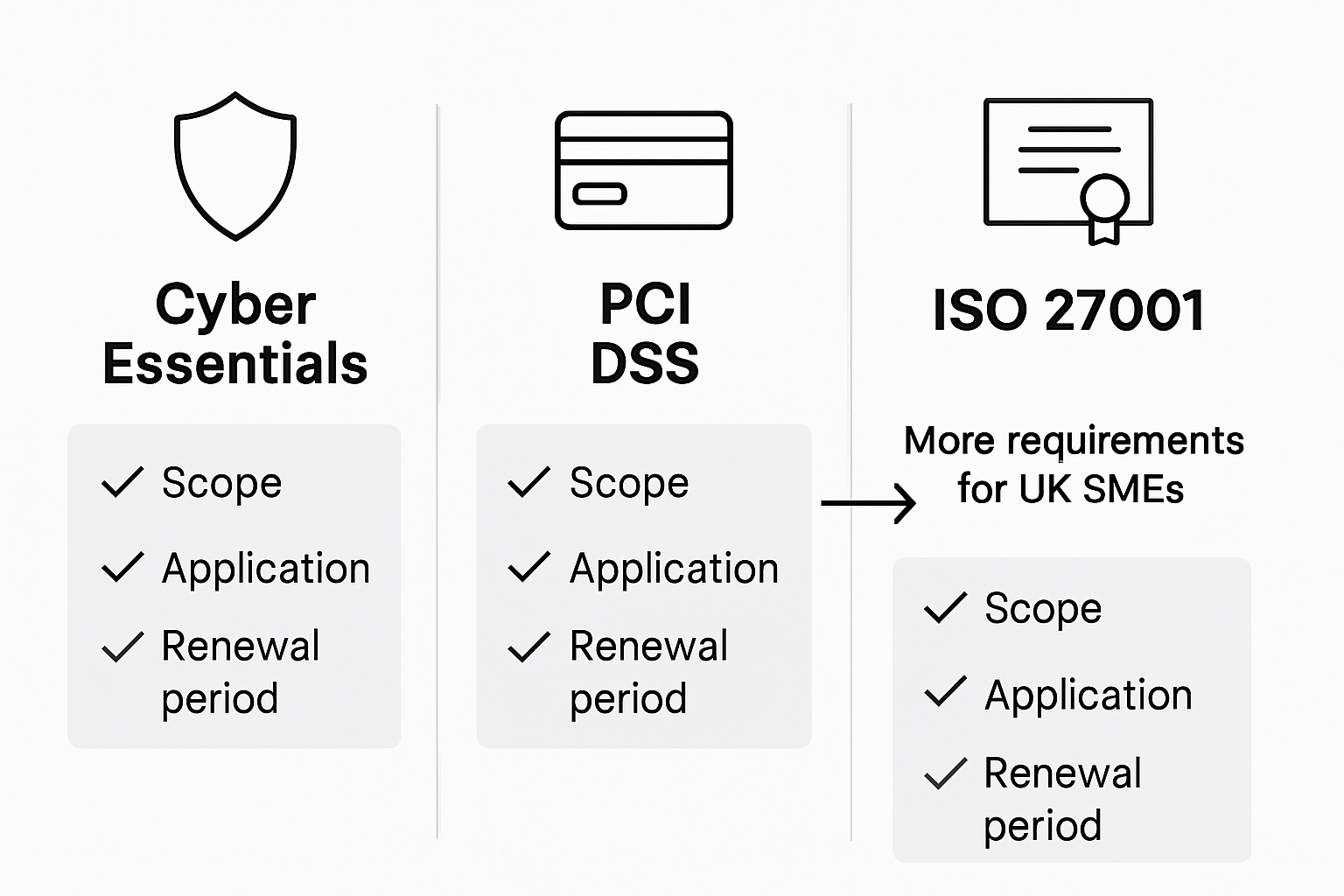
Certification Standards: Cyber Essentials, PCI DSS, ISO 27001
Small and medium enterprises (SMEs) must navigate a complex landscape of cybersecurity certification standards, each designed to protect digital assets and demonstrate robust security practices. These frameworks provide structured approaches to managing cyber risks, offering businesses crucial guidance on implementing effective security controls and meeting industry-specific compliance requirements.
Cyber Essentials represents a foundational certification scheme backed by the UK government and overseen by the National Cyber Security Centre. This standard focuses on establishing a minimum level of cybersecurity protection through annual assessments, encouraging organisations to implement essential security practices that defend against internet-based threats. The certification framework includes critical security controls designed to:
Protect internet-connected systems
Manage user access and permissions
Implement robust configuration controls
Defend against malware
Enable secure system updates
Additionally, IASME Governance provides an information assurance standard specifically tailored for SMEs, offering an affordable and straightforward approach to cybersecurity. This standard aligns closely with international frameworks like ISO/IEC 27001, creating a comprehensive approach to information security that goes beyond basic compliance requirements.
Pro Tip - Certification Strategy: Select certification standards that not only meet regulatory requirements but also provide genuine security improvements, viewing them as strategic investments in your organisation’s digital resilience rather than mere compliance checkboxes.
Here is a comparison of major cyber security certification standards relevant to UK SMEs:
Standard | Scope | Typical Application | Renewal Period |
Cyber Essentials | Basic security controls | All UK organisations | Annual |
IASME Governance | Broad information assurance | SMEs seeking comprehensive cover | Annually |
ISO 27001 | International information security | Larger or regulated businesses | Every 3 years |
Roles, Responsibilities, and Legal Obligations
Cybersecurity compliance is a complex ecosystem of interconnected responsibilities that demand clear understanding and proactive management from all organisational stakeholders. Each role within an organisation plays a crucial part in maintaining robust digital security, with specific legal and operational obligations that extend beyond traditional IT department boundaries. The evolving landscape of cyber threats requires a comprehensive, collaborative approach to protecting digital assets and sensitive information.
UK Cyber Security Forum research highlights the critical importance of defining clear cybersecurity roles and responsibilities across organisational levels. Key stakeholder responsibilities typically include:
Board of Directors: Strategic oversight and risk management
Chief Information Security Officer (CISO): Overall cybersecurity strategy and implementation
IT Managers: Technical implementation of security controls
Employees: Daily adherence to security protocols and awareness
External Compliance Partners: Independent verification and guidance
GovAssure represents a significant development in establishing structured cybersecurity governance, introducing the National Cyber Security Centre’s Cyber Assessment Framework to provide clearer guidelines for organisational accountability. This framework emphasises that cybersecurity is not merely a technical challenge but a comprehensive organisational responsibility requiring active engagement from leadership, technical teams, and individual employees.
Pro Tip - Responsibility Alignment: Develop a clear cybersecurity accountability matrix that explicitly defines each team member’s specific security responsibilities, ensuring no gaps exist in your organisation’s defensive strategy.
Risks, Costs, and Common Pitfalls in Compliance
Navigating cybersecurity compliance presents numerous challenges for small and medium enterprises, with potential risks that extend far beyond simple regulatory requirements. The financial and reputational implications of inadequate security measures can be substantial, potentially threatening an organisation’s entire operational stability. Understanding these risks requires a comprehensive approach that goes beyond checkbox compliance.
Managed detection and response services highlight the critical challenge of addressing cybersecurity skills gaps that many SMEs experience. These services reveal common compliance pitfalls that organisations frequently encounter, including:
Insufficient internal cybersecurity expertise
Inadequate threat monitoring capabilities
Reactive instead of proactive security strategies
Inconsistent implementation of security protocols
Limited understanding of emerging cyber risks
IASME Governance recognises that complex compliance standards can overwhelm resource-constrained businesses, creating significant financial and operational burdens. The potential costs of non-compliance can be devastating, encompassing direct financial penalties, legal liabilities, reputational damage, and potential business interruption. SMEs must carefully balance the investment in robust cybersecurity measures against the potentially catastrophic consequences of security failures.
Pro Tip - Risk Mitigation: Conduct regular, comprehensive risk assessments that go beyond surface-level compliance, treating cybersecurity as a strategic business investment rather than a mere regulatory requirement.
Take Control of Your Cyber Compliance with Freshcyber
Managing ongoing cyber compliance presents unique challenges for UK SMEs such as staying ahead of vulnerabilities, handling continuous monitoring, and meeting ever-changing certification standards like Cyber Essentials. The risk of last-minute audit surprises and the strain on limited internal resources are common pain points that can stop your business from demonstrating strong, reliable security.
At Freshcyber, we specialise in guiding busy directors and lean IT teams through every step of compliance with clear, practical support. Our flagship Cyber Elite service puts your Cyber Essentials certification on autopilot by delivering continuous vulnerability management and seamless recertification. This means you avoid the stress of reactive approaches and gain peace of mind knowing your security posture is actively maintained all year round.
Enhance your compliance strategy by exploring our dedicated Cyber Essentials resources and discover how our proactive Vulnerability Management solutions keep your business safe from emerging threats. To unlock steady, expert-led support designed for SMEs in the UK, visit Freshcyber today and take the first step towards effortless ongoing compliance.
Frequently Asked Questions
What are managed cyber compliance services?
Managed cyber compliance services offer comprehensive cybersecurity solutions for businesses, providing continuous monitoring, vulnerability assessments, and proactive security management to help organisations meet compliance requirements and protect against cyber threats.
How do ongoing compliance management services work?
Ongoing compliance management involves continuous monitoring and regular evaluations of an organisation’s cybersecurity measures, ensuring they adapt to new threats and maintain alignment with regulatory standards through systematic assessments and reporting.
What certification standards should SMEs consider for cybersecurity?
SMEs should consider standards such as Cyber Essentials, IASME Governance, and ISO 27001 to establish comprehensive cybersecurity measures, improve resilience, and demonstrate compliance with industry-specific regulations.
What are the risks of not implementing managed cyber compliance services?
Without managed cyber compliance services, organisations may face significant risks, including inadequate security measures, exposure to cyber attacks, regulatory penalties, financial loss, and reputational damage due to non-compliance or breaches.
Recommended
Comments